
Special Functions
Special functions such as doorbells, door openers, window contacts, garden irrigation, and scene pushbuttons require digital modules. To determine the number of modules required, first consider the number and type of special functions to be implemented.
The Schrack Smart Building Automation digital module "D1180" provides 8 digital inputs and is typically used in combination with the digital module "D1208", which provides 8 digital outputs. The digital module "D1344" combines 4 digital inputs and 4 digital outputs in a single module.
The inputs of all modules are designed for 24 V DC. Never connect higher voltages or AC voltage sources to the inputs, as this may cause irreparable damage to the module.
Depending on the wiring, the outputs can be used to switch either 24 V DC or 230 V AC. When switching 230 V loads, note that the load must be resistive and must not exceed 5 A. Conventional incandescent lamps are an example of a resistive load. LED lamps are capacitive loads and must be switched using an external relay. If in doubt, consult a qualified electrician or Smart Building Automation partner.
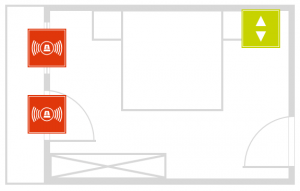
Example:
In the bedroom example, an alarm system is planned. Digital inputs are required for a pushbutton to activate and deactivate the alarm system as well as for the closing contacts of the window and balcony door.
A Schrack Smart Building Automation digital module "D1180" with 8 digital inputs is used. Four inputs are assigned to the bedroom: two for the closing contacts and two for the pushbutton. The remaining four inputs are available for other functions or rooms.
This example illustrates the planning of special functions using digital modules.